
Sheet Metal Costing & Estimation Fundamentals
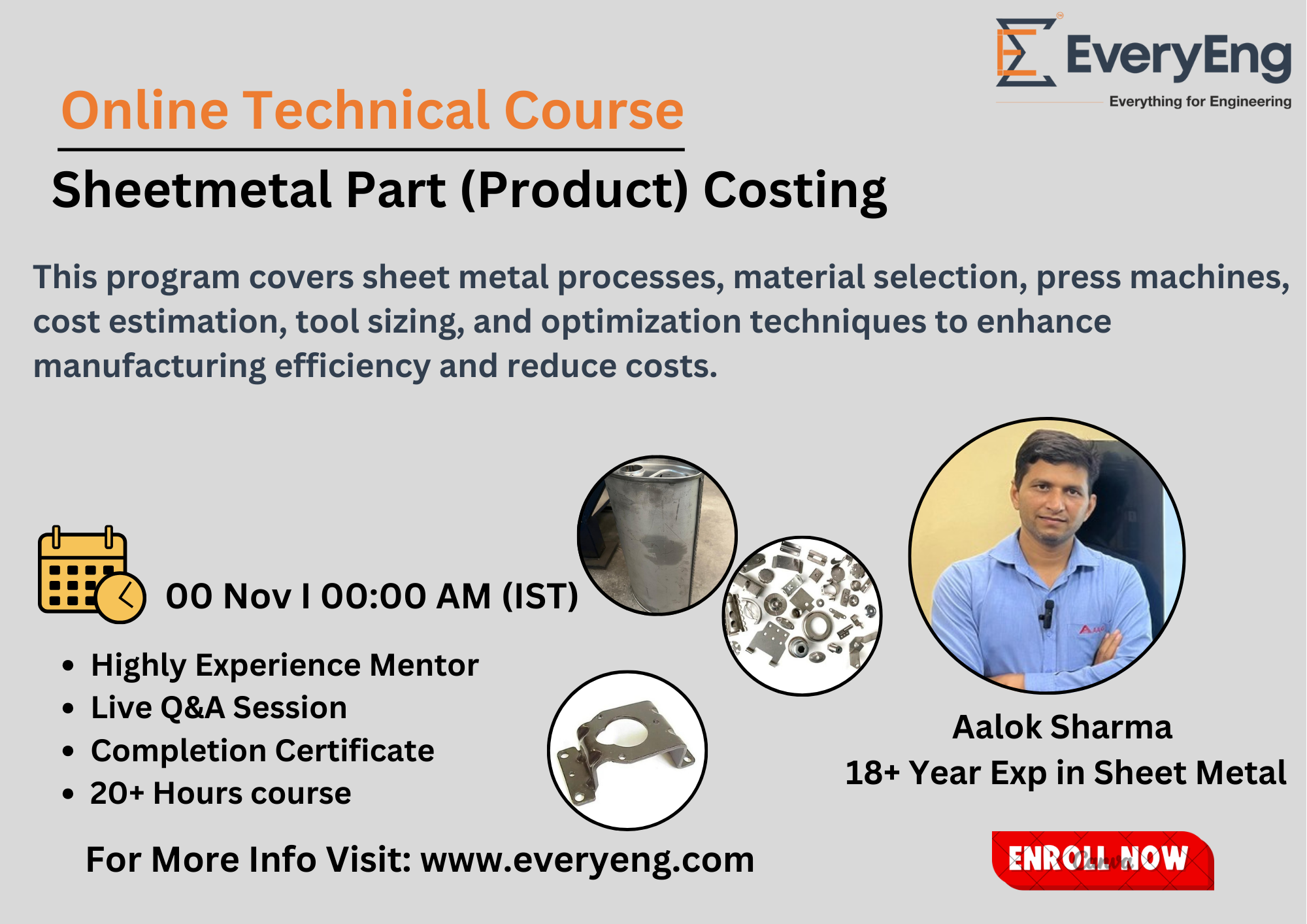
Sheet Metal Costing & Estimation Fundamentals

- 7-day money-back guarantee
- Session recordings included
- Certificate of completion
Why enroll
Is this course for you?
You should take this if
- You work in Automotive or Furniture
- You're a Mechanical / Production professional
- You prefer live, instructor-led training with Q&A
You should skip if
- You need a different specialisation outside Mechanical
- You need fully self-paced, on-demand content
Course details
Course suitable for
Key topics covered
Opportunities that await you!
Career opportunities
Training details
This is a live course that has a scheduled start date.
Our Alumni Work At
Why people choose EveryEng
Industry-aligned courses, expert training, hands-on learning, recognized certifications, and job opportunities-all in a flexible and supportive environment.
What learners say about this course

Initially, I wasn’t sure what to expect from this course. The content ended up being closer to what happens on an automotive shop floor than most classroom-style trainings. The drawing study section went beyond reading prints and actually tied GD&T decisions to product cost and downstream issues, which aligns with how BIW teams work in production. Tolerance stack-up and datum strategy were discussed in a practical way, including edge cases like weld distortion and sheet metal springback that don’t always show up in CAD. The coverage of welding fixture design and line layout felt realistic. Concepts like locating schemes, re-spotting allowances, and basic time study were comparable to standard OEM practices, not just textbook layouts. One challenge was mentally shifting from ideal tool design to cost-constrained tooling; balancing robustness with cycle time isn’t trivial, especially when change points are expected. A useful takeaway was a structured approach to drawing review—checking tolerances, weld symbols, and manufacturability before tooling kickoff. That alone can prevent late-stage fixture rework. The system-level view, from drawing to line layout, helped connect decisions that are often handled in silos. Overall, it felt grounded in real engineering practice.

Coming into this course, I had some prior exposure to the subject, mainly from reviewing supplier quotes and rough BOM estimates. What this course helped with was breaking down where the numbers actually come from. The sections on cutting methods and bend sequencing were especially relevant. In automotive brackets I’ve worked on, small changes in bend count or laser vs. plasma cutting had a bigger cost impact than expected. The explanation of how batch size affects setup cost also cleared up a gap I had from past procurement discussions. One challenge was translating the generic examples into my own work context at first. I’m currently involved in sourcing sheet metal enclosures for an agriculture equipment project, and the early exercises felt simplified. After reworking the examples using our real material thicknesses and finish requirements, it clicked. A practical takeaway was learning to estimate cost impact during design reviews instead of waiting for supplier feedback. That’s already helped in a furniture fixture project where weld count and surface finish were driving costs unnecessarily. The course didn’t oversell tools, but showed where spreadsheets still make sense. It definitely strengthened my technical clarity.
At first glance, the topics looked familiar, but the depth surprised me. Coming from an automotive supplier environment, sheet metal costing was always handled by purchasing, so the real cost drivers behind brackets and small enclosures were a bit of a black box. This course broke that down clearly, especially around how material thickness, nesting efficiency, and bend count quietly push costs up. One section that clicked was comparing laser cutting versus turret punching, which is directly applicable to an automotive battery tray project I’m supporting now. The examples around agricultural equipment panels were also useful, since those parts often look simple but get expensive once welding and finishing are added. Furniture frames came up too, and it was interesting to see how batch size changes the whole equation there. A challenge was wrapping my head around how shops actually estimate labor time versus what CAD says, since the numbers don’t always line up cleanly. Still, a practical takeaway was learning to adjust designs early—like reducing bend complexity—to avoid unnecessary tooling and setup costs. This course filled a gap between design intent and supplier quotes, and it’s already helping in RFQ discussions. It definitely strengthened my technical clarity.