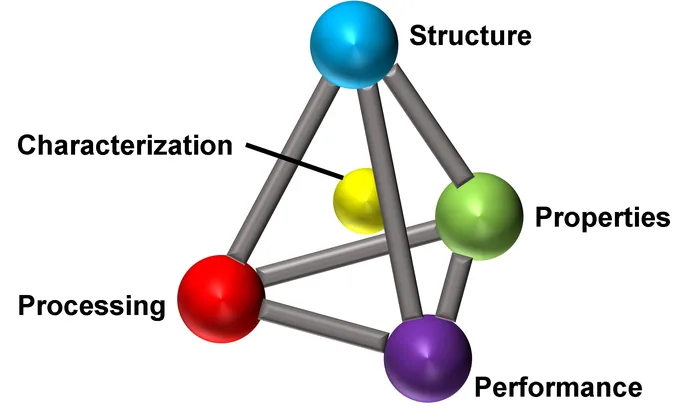
This 20 hour crash course is designed to understand the processing-structure-property-applications co-relationships in different materials. It offers an in-depth exploration of essential topics in materials science covering atomic structure and bonding, material characterization methods, mechanical testing, diffusion, and phase transformations. Participants will gain a solid understanding of different engineering materials and how their properties can be manipulated to obtain high quality and more reliable advanced materials needed to maximize part performance, application regime, and customer satisfaction.
Course Modules
📌 Module 1: Atomic Structure and Bonding in Materials
This module introduces various types of engineering materials (metals, alloys, ceramics, polymers, and composites). It explores ionic, covalent, metallic, and Van der Waals bonding and crystal structures in metals and ceramics.
A solid understanding of atomic structure and bonding principles is essential for predicting material properties and behaviors. This knowledge is key to designing and developing new materials with tailored properties required for synthesis and fabrication of more efficient, durable, and innovative products.
📌 Module 2: Materials Characterization
This module will cover a variety of material characterization techniques, including optical microscopy, scanning electron microscopy, transmission electron microscopy, and X-ray diffraction. Material characterization provides critical insights into the chemical, physical, mechanical, and electrical properties of materials.
By employing these techniques, one can visualize structures and perform more precise material analysis. This deeper understanding helps in identifying defects, optimizing material performance, and improving manufacturing processes. The ability to characterize materials accurately is crucial for advancing innovations in different fields such as nano engineering, mechanical engineering, materials engineering, and structural engineering.
📌 Module 3: Testing of Materials
This module will cover a variety of mechanical testing methods, including hardness testing, tensile testing, compression testing, fatigue testing, and impact testing. These techniques are essential for evaluating and predicting the mechanical properties of materials such as strength, ductility, toughness, and resistance to wear or failure. Understanding these properties is critical for determining how materials will perform under different conditions such as stress, load, and temperatures.
By accurately assessing the mechanical behavior of materials, one can ensure their suitability for specific applications, optimize designs for durability and safety, and enhance overall product performance. These testing methods also help in identifying material limitations and guiding improvements for materials development and quality control.
📌 Module 4: Diffusion and Phase Transformations in Materials
This module will explore the fundamentals of diffusion processes, driving forces behind them, key influencing factors, diffusion types, and their underlying mechanisms. Fick's Laws of diffusion will be discussed with their mathematical formulations and practical applications.
In addition, the module will delve into the Iron-Carbon phase diagram, a critical tool for understanding phase transformations in steels, including the formation of different microstructures like austenite, ferrite, and pearlite. Heat treatment processes, such as annealing, quenching, and tempering, will be examined in the context of their impact on the mechanical properties and microstructures of steels and metallic alloys. By understanding these concepts, students will gain insights into controlling material properties for engineering applications, such as enhancing strength, toughness, and wear resistance in industrial components.